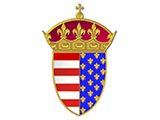

In a momentous occasion that honours centuries of history, Robert Dryden, the Master of the Order of St. George the Martyr, has made an official visit to the historic towns of Celle San Vito, Castelluccio Valmaggiore and Faeto, provinces of the city of Foggia, in the region of Apulia, which also have their Historical connection with the Order of St George during the French Domination of the House of Anjou, in the medieval period between the 13th and 15th centuries.
It was here where Charles I Anjou started his invasion towards the southern regions of Italy: the island of Sicily, Calabria and Apulia, which were under the Kingdom of Naples in the region of Campania, in Italy. Charles I Anjou crossed Brindisi, another town in Apulia to prepare for a campaign against Sicily. However, he fell seriously ill before travelling to Foggia, where he died on 7th January 1285 (aged 57-59). He was buried in a marble sepulchre in Naples, but his heart was placed at the Couvent Saint-Jacques in Paris. His corpse was moved to a chapel of the newly built Naples Cathedral in 1296.

Castelluccio Valmaggiore, near Foggia, a picturesque town nestled in the Apennines of southern Italy, together with Celle San Vito and Faeto are steeped in historical significance. It is precisely walking on foot through the narrow alleys of these characteristic villages you can still see the names in the Provencal language, reminding us of the French historical presence so still alive nowadays. Robert Dryden's pilgrimage to this sacred location serves as a poignant reminder of the Order’s long-standing traditions.

During his visit, Grand Master Dryden met with the Mayor of Castelluccio Valmaggiore, Sir Pasquale Marchese, to discuss the historical importance of the area and the enduring legacy left by the Royal Anjou Family, while admiring the beauty of nature that surrounds the place. The meeting between the Grand Master and the Mayor emphasized the deep-rooted connection between the Order and the town, celebrating both the past and its continued relevance in modern times.
“The significance of this area to our Order cannot be overstated”, remarked Robert Dryden. “Charles Robert I Anjou, the crowned King of Hungary, was a monarch of vision and devotion, who laid the foundation for the principles that still guide us today. It is humbling to stand in a place so closely connected to the origins of our mission”.

The Mayor expressed his gratitude for the Grand Master’s visit, stating that Castelluccio Valmaggiore, Faeto and Celle San Vito are proud of its historical heritage and their ties to the Order of St. George the Martyr.
“This visit is a powerful reminder of the important role our town has played in history. The legacy lives on not just in Italy, but across the world through the work of the Order”, Mayor Marchese said.


The visit concluded with a wreath-laying ceremony at the memorial site of Charles I Anjou in the village of Celle San Vito. Both Dryden and the Mayor paid their respects to the king, who was the great grandfather of Charles Robert I, King of Hungary, founder of the of St. George in 1326, whose vision continues to inspire us.
This symbolic visit highlights the importance of preserving historical traditions while fostering connections between the past and the present. Robert Dryden’s journey to the area serves as a testament to the enduring legacy thank to the House of Anjou, a legacy that continues to inspire and guide its members to this day.

Royal Palace of the King Charles II Anjou, the Medieval Castel, the so called “Castel Nuovo“ or “Maschio Angioino” from the Anjou House. Located in central Naples, Campania, Italy. Built in 1279, one of the main architectural landmarks of the City of Naples.
In reference to History, those significant places visited in Apulia by Robert Dryden, the Master of St George Order, near the Region of Campania, are the witness of the southern regions ruled by the Kingdom of Anjou in Naples, the Great City whose History and Cultural Heritage of the Order of St George belongs to.
It was precisely from Naples, the young Prince Charles Robert (the so called Caroberto), aged only twelve, was sent to Hungary. He was the only son of Charles Martel, Prince of Salerno, near Naples, and the grandchild of Charles II, the King of Naples and his consort Queen Mary of Hungary. He was ordered by his grandfather King Charles II, with the Papal support, to claim the throne of Hungary. The young Caroberto, was crowned with the Holy Crown of St Stephen by the Archbishop of Esztergom in 1310. He became Charles Robert I, the King of Hungary. A period of reform in all areas of the governance of Hungary as well a period of peace and prosperity started to flourish in Hungary, and during which the fraternal society of knights was established and evolved into an order of chivalry named after St George by 23rd April 1326. The Order of St George, founded by the King Charles Robert I in Hungary in 1326,was the first secular order of Knights, and it was established to protect pilgrims, uphold Christian values and restore Peace during an era of great turmoil in Europe.
Historically, the Royal House of Anjou ruled in France, Italy, Hungary, Croatia, Albania and Poland. The Order of St George, started its journey from Naples Historical Anjou Heritage to Hungary, still now continues its mission and well active as a charity organization in the United Kingdom that supports charitable and humanitarian causes.

Naples, House Anjou Crest

Napoli - Castel Nuovo
“Looking at these historical and monumental places, we breath History that reminds us how West and East countries are united to the entire World and deeply rooted in the Great History of their Past, which remains Eternal in our Present and for the Future generations”.
by Professor Anna Di Giovannantonio
Ambassador for Naples, Dame Commander of the Order of St George
Consular Correspondent for the Italian Community in Cambridge